
Background to legislative work
Space technologies and applications are used every day by citizens, businesses and governments. They provide essential services in areas as diverse as weather forecasting, global communications and networking, monitoring and managing transport and energy networks, preventing and mitigating natural disasters, climate and environmental monitoring, and satellite navigation. All of these terrestrial applications – and many more – rely on the data provided by satellites in orbit. The infrastructures that use space data contribute in many different ways to the security and stability of the economy and society, and therefore to prosperity. Space activities also significantly improve our scientific understanding of space, the Earth and humankind.
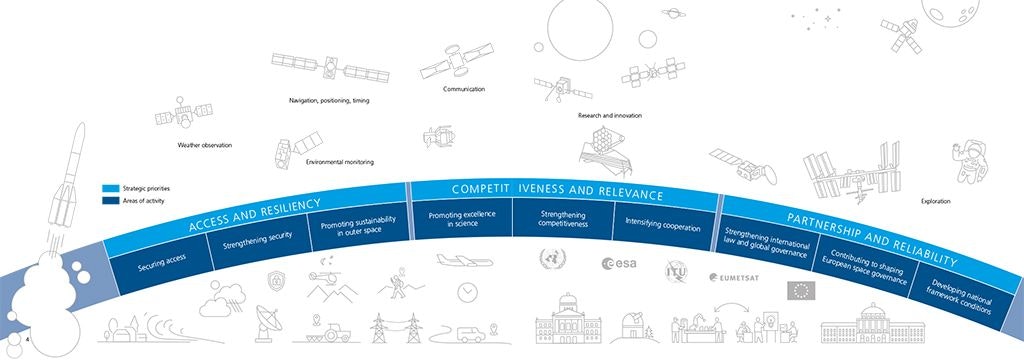
In recent decades, there have been rapid and powerful advances in the space sector all over the world. The commercialisation of the sector is opening up new opportunities. In Switzerland, too, the number of public and private actors active in this field is growing.
The 2023 Space Policy (adopted by the Federal Council in April 2023) serves as a guide for the Confederation's activities in space and as a political guideline for the space legislation currently being developed. This first federal act on space operations will provide public and private stakeholders in the space sector with a legal framework that is both flexible and reliable.
On 25 February 2026, the Federal Council submitted the draft bill together with its dispatch to Parliament. The Federal Assembly is now deliberating on the proposal. The new Federal Act on Space Operations and the corresponding ordinance of the Federal Council are not expected to enter into force before 2028.